




How to Fix General Electric Washing Machine Will Not Spin
Have you ever wondered why your clothes come out soaking wet after a wash cycle? This common issue often points to a pause in the cycle, a failure to drain, or a halt before reaching high-speed spinning. Understanding these scenarios is crucial for effective troubleshooting.
For instance, a full-size GE top-load washer may pause for up to three minutes before it begins to pump out water. This initial delay can be confusing, as it may seem like a malfunction. However, it’s essential to differentiate between a normal pause and a genuine problem.
GE Appliances' official guidance for a top-load washer that does not spin confirms that pauses of up to three minutes can occur between stages, and the pump-out process itself may take additional time before spinning begins.
In this article, readers will discover a logical approach to diagnosing issues, starting with checking power, load balance, lid position, drainage, and visible damage. Safety comes first; always disconnect electrical power before inspecting internal components.
If your washer pumps out water but still doesn't spin, Super Fix Appliances can help determine whether the problem involves the lid lock, belt, motor, suspension, sensor, drainage system, or electronic controls.
Key Takeaways
- Wet clothes may indicate a normal pause, poor drainage, load imbalance, or spin-system fault.
- Some full-size GE top-load washers may pause for up to three minutes before pump-out.
- Check power, load balance, lid position, and drainage before assuming a major component has failed.
- Disconnect power before inspecting internal components.
- Persistent spin problems may require professional diagnosis.
Introduction to GE Washers and Spin Issues
Have you ever faced the frustration of pulling wet clothes from your washer after a cycle? This is a common symptom when a washer fails to reach full spin speed.
Symptoms can include:
- Soaked clothing
- An inactive basket
- Interrupted cycles
- Standing water
- Flashing indicators or control-panel messages
Full-size and space-saving GE top-load designs can behave differently. On certain space-saving models, dE or E2 can appear when the lid is opened during a cycle.
GE's official support guidance says these codes may flash for approximately 30 seconds. Closing the lid and pressing Start/Pause restarts the interrupted cycle on applicable models.
Diagnosis depends on the washer's design, age, model number, and control layout. It's also important to check whether water remains inside the tub because incomplete drainage can prevent high-speed spinning.
| Washer Type | Common Symptoms | Possible Indicators |
|---|---|---|
| Full-Size Top Load | Wet clothes, inactive basket, delayed spin | Pause before pump-out |
| Space-Saving Top Load | Interrupted cycle after lid opens | dE or E2 on applicable models |
| Front Load | Wet laundry, standing water, locked door | Model-specific drain, lock, or control codes |
| Multiple Designs | Incomplete cycle | Imbalance, drainage, power, or component fault |
Understanding the Spin Cycle Functionality
Do you often find yourself puzzled by wet clothes after a completed wash? The wash cycle in a GE top-load washer involves several stages, including filling, agitation, draining, and high-speed spinning.
After agitation, some full-size GE top-load washers normally pause before pumping out the water.
GE specifically advises users not to manually advance the timer during this pause, because doing so could skip the pump-out stage.
Many washing machines also need to drain sufficiently before beginning high-speed spin. If water remains in the tub, the washer may delay or prevent spinning.
This distinction helps separate:
- A normal programmed pause
- A drainage failure
- A load-balance problem
- A safety-interlock problem
- A mechanical or electronic fault
Diagnosing Why the General Electric Washing Machine Will Not Spin
Have you experienced a washer that seems to wash normally but won't spin? Several different problems can create the same symptom.
Common areas to investigate include:
| Possible Cause | Typical Symptom | Why It Matters |
|---|---|---|
| Lid switch or door lock | Washer refuses to enter spin | Safety system may not confirm closure |
| Drive belt | Motor operates but basket does not rotate correctly | Belt may be loose, worn, or broken |
| Motor coupling or drive component | Little or no drum movement | Motor force may not reach the basket |
| Drainage problem | Standing water and wet clothes | Washer may delay high-speed spin |
| Load imbalance | Spin starts, slows, or stops | Protection system may limit spin speed |
| Control or sensor fault | Inconsistent cycle behavior | Electronic diagnosis may be required |
The original draft assigned specific percentages to the lid switch, drive belt, and motor coupling. Those percentages did not have a supporting source, so they should not be published as factual failure rates.
Visible symptoms also do not prove which component has failed. Model-specific diagnosis matters before ordering replacement parts.
Checking Electrical Supply and Power Concerns
Imagine discovering that your wet-clothes problem is actually caused by the power supply rather than the washer itself.
Before assuming component failure:
- Confirm the washer is plugged in securely.
- Check the household circuit breaker or fuse.
- Inspect the power cord for obvious cuts, crushing, or heat damage.
- Check whether the wall outlet is supplying power.
GE suggests carefully testing the outlet with another small working appliance, such as a table lamp or hair dryer.
| Issue | Possible Cause | Recommended Action |
|---|---|---|
| Washer not powering on | Blown fuse or loss of power | Check household electrical supply |
| Breaker repeatedly trips | Circuit or washer electrical fault | Stop using washer and consult a qualified professional |
| Outlet inactive | Outlet or circuit problem | Confirm with another device and use an electrician if faulty |
| Cord visibly damaged | Electrical damage | Disconnect washer and arrange repair |
If a breaker repeatedly trips, an outlet smells burnt, shows discoloration, or becomes unusually hot, stop using the appliance and seek qualified electrical assistance.
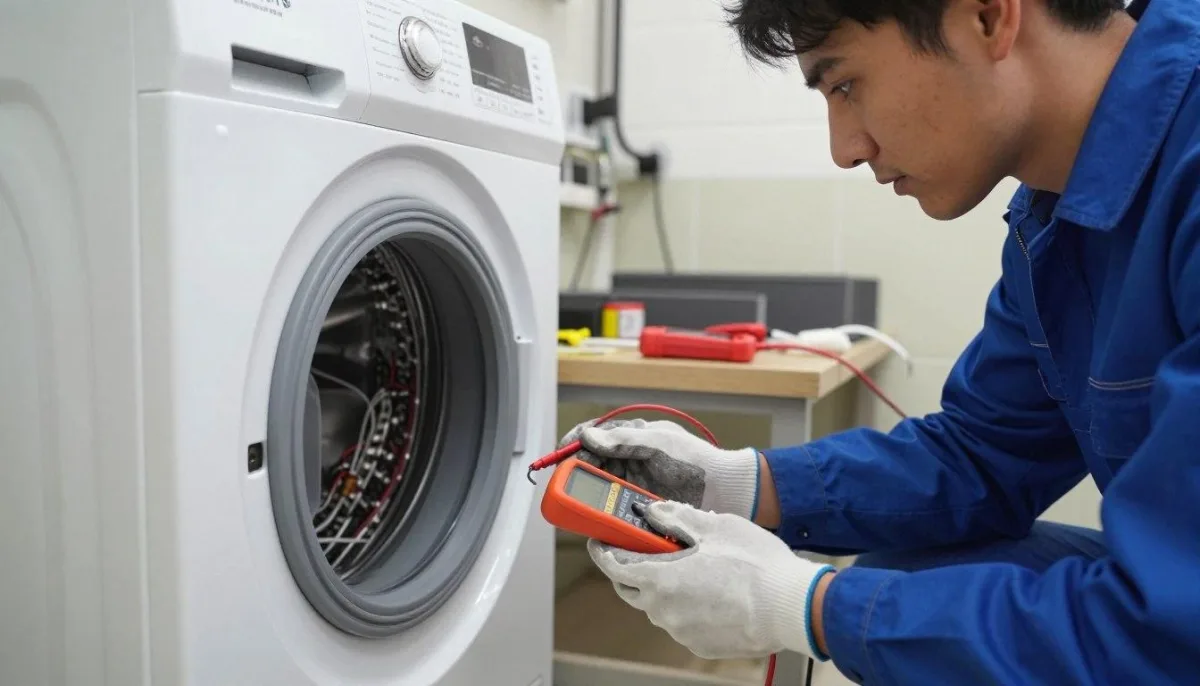
Examining the Washer Lid Switch and Door Latch
Do you find it frustrating when your laundry comes out wet despite the cycle appearing to run? The lid switch or door-lock system can be responsible.
These components act as safety interlocks. They prevent unsafe operation when the lid or door is not securely closed.
For applicable GE space-saving models, dE or E2 can indicate that the lid was opened during the cycle. GE advises closing the lid and pressing Start/Pause to restart the interrupted cycle.
Inspect the latch area for:
- Misalignment
- Broken plastic
- Visible physical damage
- Debris preventing proper closure
- Loose or visibly damaged wiring
A latch that no longer engages properly can also interrupt the spin cycle.
When the appliance is disconnected from power, a trained person may use model-specific de-energized continuity testing to assess certain switches.
Never bypass a lid switch, door lock, or other safety interlock.
A switch can appear mechanically closed while its electrical contacts have failed, so replacement should only be considered after identifying the correct component for the exact GE model.
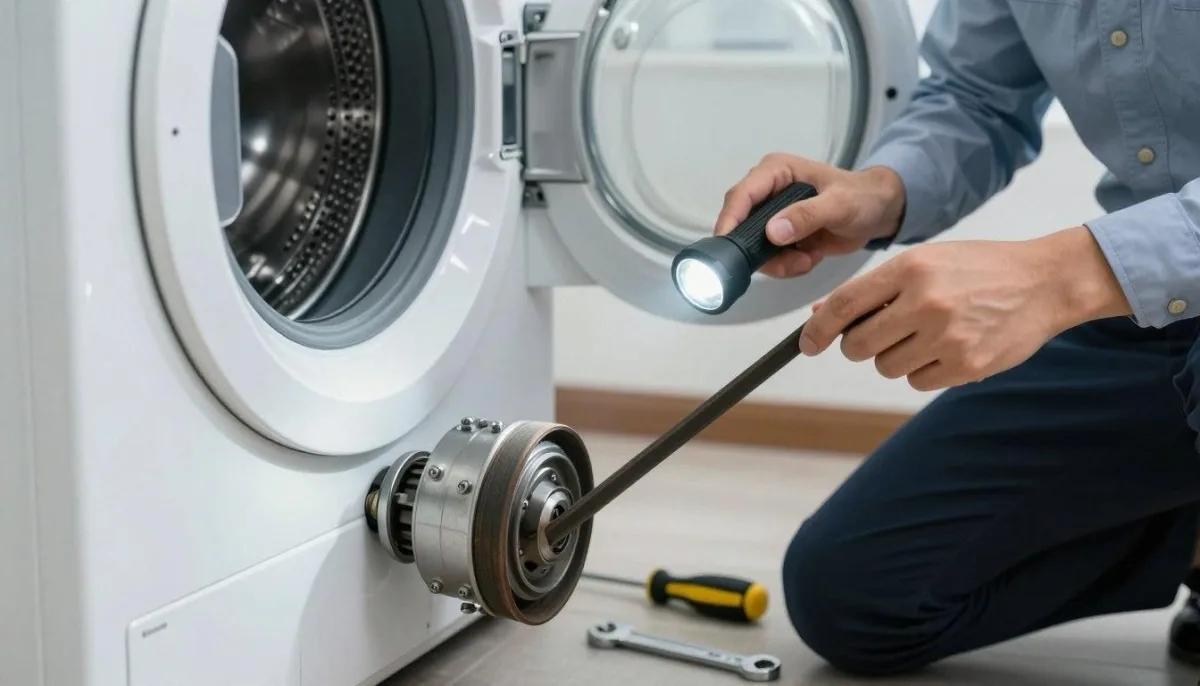
Inspecting the Drive Belt and Motor Coupling
Have you ever found your laundry still damp after the cycle and wondered whether the drive system is responsible?
On GE models that use a drive belt, a damaged belt can prevent normal washing or spinning.
Before inspecting anything behind an access panel, disconnect the appliance from electrical power.
Where safe access is permitted by the model's service instructions, inspect for:
- Fraying
- Cracking
- Stretching
- Slippage
- Grease contamination
- Misaligned pulleys
A basket or drum that rotates unusually freely while disconnected from power can sometimes indicate a disconnected or broken drive component, although this varies by washer design.
The motor coupling, where fitted, transfers rotation through the drive system. A failed coupling may leave broken plastic or rubber pieces inside the cabinet.
Motor symptoms such as overheating, difficulty starting, repeated stopping, or a burning smell require professional diagnosis.
| Component | Common Issue | Signs to Check |
|---|---|---|
| Drive Belt | Worn, slipping, broken | Fraying, cracking, stretching |
| Motor Coupling | Failed or damaged | Broken drive pieces, no effective drum movement |
| Motor | Overheating or starting problem | Abnormal noise, heat, repeated failed starts |
Do not order a motor or drive component solely from the symptom "won't spin." GE washer designs vary significantly between models.
Analyzing Suspension System and Leveling Issues
Do you find it strange when your washer shakes violently and interrupts spinning? An unstable floor, poor leveling, load imbalance, or worn suspension components can all contribute.
To improve stability:
- Remove excess laundry if the basket is overloaded.
- Redistribute heavy items evenly.
- Use a bubble level to check the appliance front-to-back and side-to-side.
- Follow the exact GE owner's manual for adjusting the leveling feet on your model.
- Where fitted, inspect accessible suspension components for visible damage or leakage.
- If one suspension component has failed, ask whether the set should be replaced together according to the model's service procedure.
GE's guidance on wet clothes and out-of-balance conditions also recommends redistributing the load and making sure the washer itself is level.
For additional Dubai-specific issues involving vibration, drainage, electronics, and local operating conditions, see The Washing Machine Problems Every Dubai Household Eventually Faces.
Evaluating Water Drainage and Pump Operation
Is it puzzling to see your clothes still wet after a wash cycle? Standing water is an important clue.
If water remains in the tub, the washer may not proceed to full-speed spinning.
On front-load models equipped with a user-accessible pump filter, it may be located behind a lower access panel. Check your exact model manual before opening anything.
Prepare towels or a shallow container because retained water may escape when the filter is opened.
Look for:
- Lint
- Coins
- Hair ties
- Small clothing items
- Other debris
- A kinked or restricted drain hose
A pump that hums but fails to move water may have a blocked impeller or another pump problem.
GE's official washer troubleshooting guide likewise recommends checking the pump, drain hose, and drainage path when water is not leaving the machine.
The original draft specified a universal 10-20 ohm pump measurement. That has been removed because electrical specifications are model-specific and should be confirmed from the correct technical documentation.
If the filter and accessible drain path are clear but the washer still fails to drain or spin, professional washing machine repair in Dubai can determine whether the problem involves the pump, motor, belt, lock, sensor, or electronic controls.
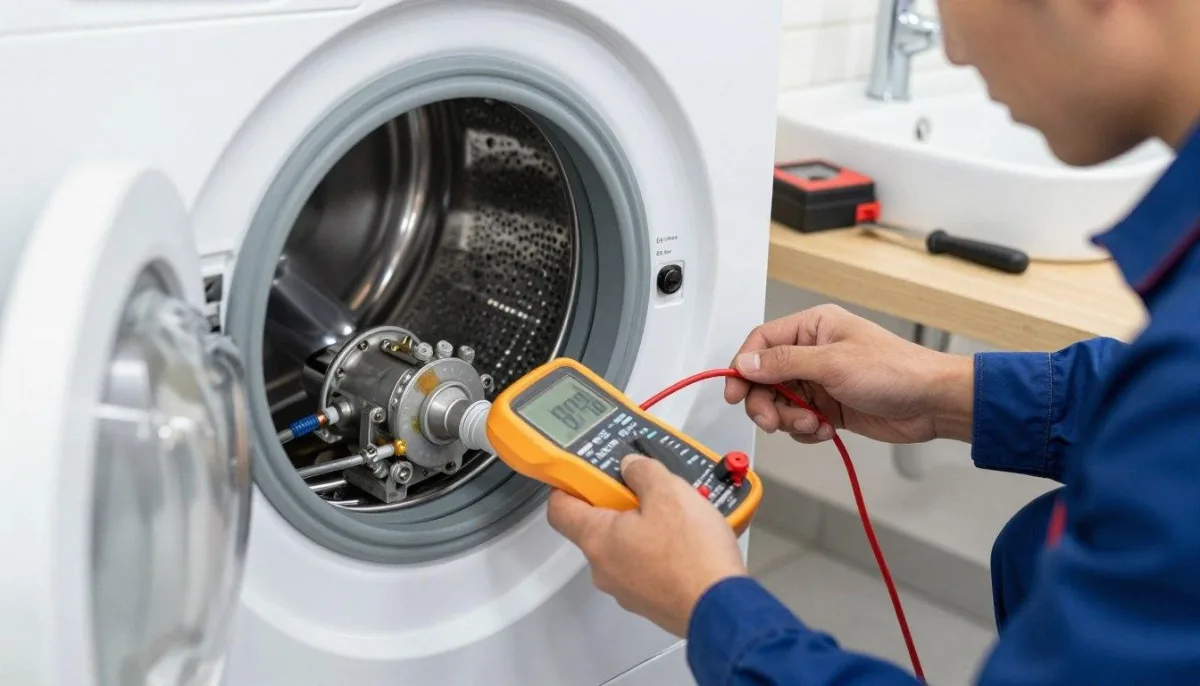
Investigating the Pressure Switch, Sensor, and Tub Airflow
Have you ever noticed that your washer seems unable to determine the correct water level? A water-level pressure switch or electronic pressure sensor can affect drainage and spin decisions.
Different GE models use different pressure-sensing systems, so resistance values, wiring configurations, and test procedures should not be treated as universal.
A basic inspection may include checking the accessible pressure tube, while the appliance is unplugged, for:
- Kinks
- Loose connections
- Visible residue
- Cracks
- Blockages around accessible tubing
Avoid applying pressure directly to an electronic sensor or introducing household cleaners into the pressure system unless GE's service information for the exact model specifically instructs you to do so.
Sensor electrical diagnosis is better handled with model-specific service information and appropriate training.
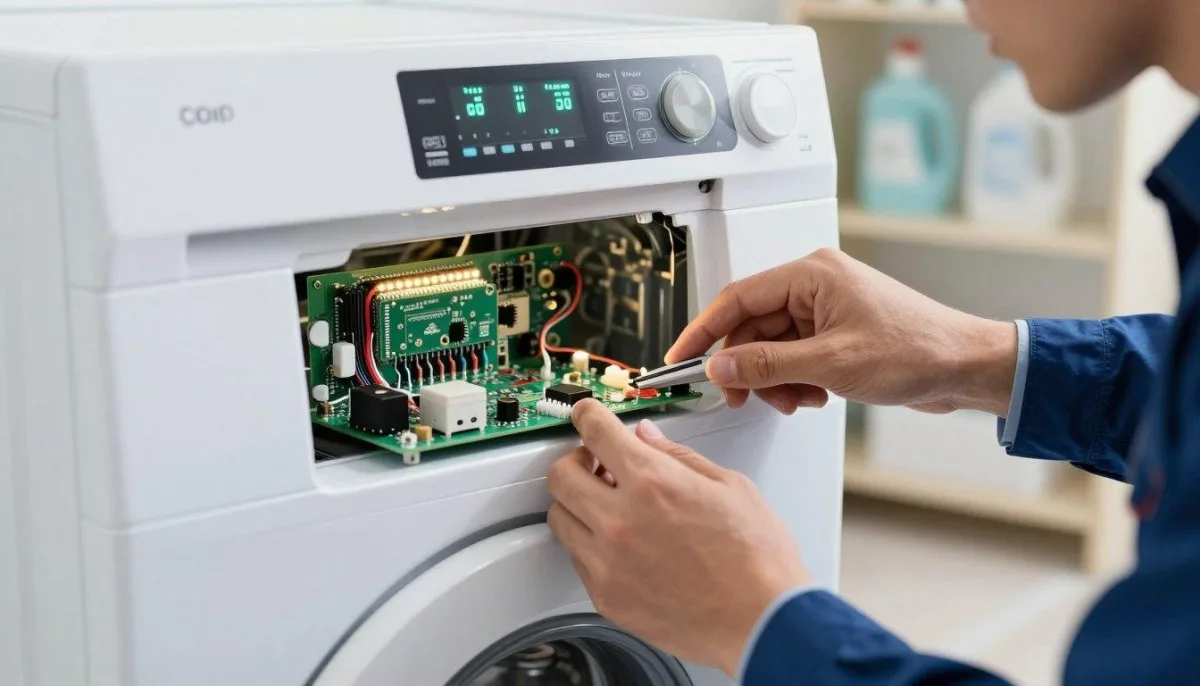
Resetting the Control Board and Interpreting Error Codes
Is it confusing when your washer appears operational but fails to complete its cycle? Sometimes a control interruption can be cleared by resetting the washer.
GE's instructions vary by model and symptom.
For certain newer top-load models displaying CAnCELEd, GE's no-spin guidance recommends attempting Drain & Spin and, if the condition remains, disconnecting power for about one minute before retrying.
GE's broader electronic-control reset guidance advises unplugging the washer or switching off its circuit for approximately two minutes on applicable electronic-control models.
Because these procedures vary, follow the instructions for your exact GE model rather than assuming a longer reset is always better.
Before resetting, record:
- The exact display message
- Which lights are flashing
- When the problem occurs
- Whether water remains in the tub
| Message / Indicator | Likely Meaning on Applicable GE Models | First Action |
|---|---|---|
CAnCELEd |
Cycle/control error | Try Drain & Spin; reset if needed |
dE / E2 |
Lid opened on certain space-saving models | Close lid and restart |
| Flashing Spin light | Out-of-balance condition | Redistribute load |
bALAnCINg |
Washer attempting to correct imbalance | Allow redistribution or rebalance manually |
Important correction: the original draft listed E2 as a drainage error in one table but described it as a lid-open indicator elsewhere. GE's official no-spin guidance supports the lid-open meaning for the applicable space-saving models, so the contradiction has been corrected here.
Practical Steps for Proper Load Distribution
Do you often find that washer performance changes depending on the laundry load? Proper distribution is critical for high-speed spinning.
Rather than relying on one universal fill percentage, follow the load-capacity instructions for your exact GE model.
As a general practice:
- Load items loosely rather than packing them tightly.
- Distribute clothes evenly around the basket.
- Avoid allowing heavy towels, jeans, blankets, or bedding to bunch on one side.
- Pause and redistribute an uneven load when the washer safely allows access.
- Remove one or more heavy items if repeated balancing attempts fail.
On applicable 2015-and-newer GE top-load models, a flashing Spin light or bALAnCINg display can indicate an out-of-balance condition rather than immediate mechanical failure.
GE recommends redistributing the laundry and running Drain & Spin when clothes remain wetter than expected.
Finally, make sure the washer sits on a stable, level surface. Poor leveling can turn an otherwise normal laundry load into a recurring balance problem.
Preventive Maintenance for Long-Term Spin Performance
Do you realize that proactive care can reduce many spin-related problems?
Useful maintenance includes:
- Cleaning a user-serviceable pump filter at the interval recommended for your GE model.
- Checking drainage hoses for kinks, deterioration, or restrictions.
- Keeping the washer level.
- Loading laundry evenly.
- Inspecting door locks and lid areas for visible damage.
- Listening for developing grinding, squealing, or abnormal motor sounds.
- Recording recurring error messages instead of repeatedly resetting the washer.
- Having drive and suspension components inspected when symptoms suggest wear.
Where a belt is fitted, inspect it according to the model's service requirements. Belt life varies significantly with design, loading habits, environment, and usage, so a fixed lifespan should not be assumed.
A well-maintained washer can remain useful for many years, but there is no single lifespan that applies to every GE washing machine. Usage, maintenance, repair history, model design, parts availability, and operating conditions all matter.
For more preventive advice relevant to Dubai homes, the previous Super Fix guide The Washing Machine Problems Every Dubai Household Eventually Faces covers drainage, leveling, environmental wear, filters, electronics, and maintenance.
Cost Considerations: Repair Versus Replacement
Have you ever considered whether repairing the washer still makes financial sense?
Repair cost depends on:
- Exact GE model
- Failed component
- Part availability
- Washer age
- Labor required
- Whether several components are failing
- Existing warranty coverage
- Overall appliance condition
A lid switch, belt, or accessible drainage problem will usually represent a different repair scope from a motor, control board, bearing, or major drive-system failure.
The original draft included U.S. dollar ranges for these repairs. Those figures should not be presented as Dubai prices, because UAE labor, part availability, model support, and import costs differ.
For Dubai readers, the more useful approach is to obtain a written diagnosis and local quote before deciding.
A commonly used rule of thumb is to think carefully about replacement when repair cost approaches a substantial percentage of the price of an equivalent new washer, particularly when the appliance is already older or has experienced repeated failures.
| Decision Factor | Repair May Make More Sense | Replacement May Make More Sense |
|---|---|---|
| Washer age | Relatively young | Near end of practical service life |
| Fault | Single repairable component | Multiple major failures |
| Parts | Readily available | Obsolete or difficult to source |
| Repair history | First major issue | Repeated breakdowns |
| Cost | Clearly below replacement value | Approaching new-machine cost |
| Warranty | Repair still covered | No coverage and costly failure |
A technician from Super Fix Appliances' washing machine repair service can diagnose the fault and quote the required repair before major work begins.
Detailed Troubleshooting: Step-by-Step Technical Guide
Have you ever encountered a situation where your laundry remains damp even though the cycle appears complete? Work through the problem from the simplest checks toward the more complex ones.
Step 1: Check the Load
Redistribute heavy or tangled items evenly.
Step 2: Confirm the Lid or Door
Make sure the lid or door closes and locks normally.
Step 3: Check for Standing Water
If water remains inside, investigate drainage before treating the problem as a drive-system fault.
Step 4: Inspect the Accessible Drain Path
Check the drain hose and any user-serviceable filter according to the owner's manual.
Step 5: Record Error Indicators
Write down exact codes, messages, and flashing lights.
Step 6: Use the Correct GE Reset
Follow the reset procedure for the exact washer model rather than repeatedly unplugging and restarting the appliance.
Step 7: Run Drain & Spin Where Appropriate
Once basic checks are complete and the appliance is safe to operate, use Drain & Spin or the model-equivalent cycle to see whether drainage and spinning resume.
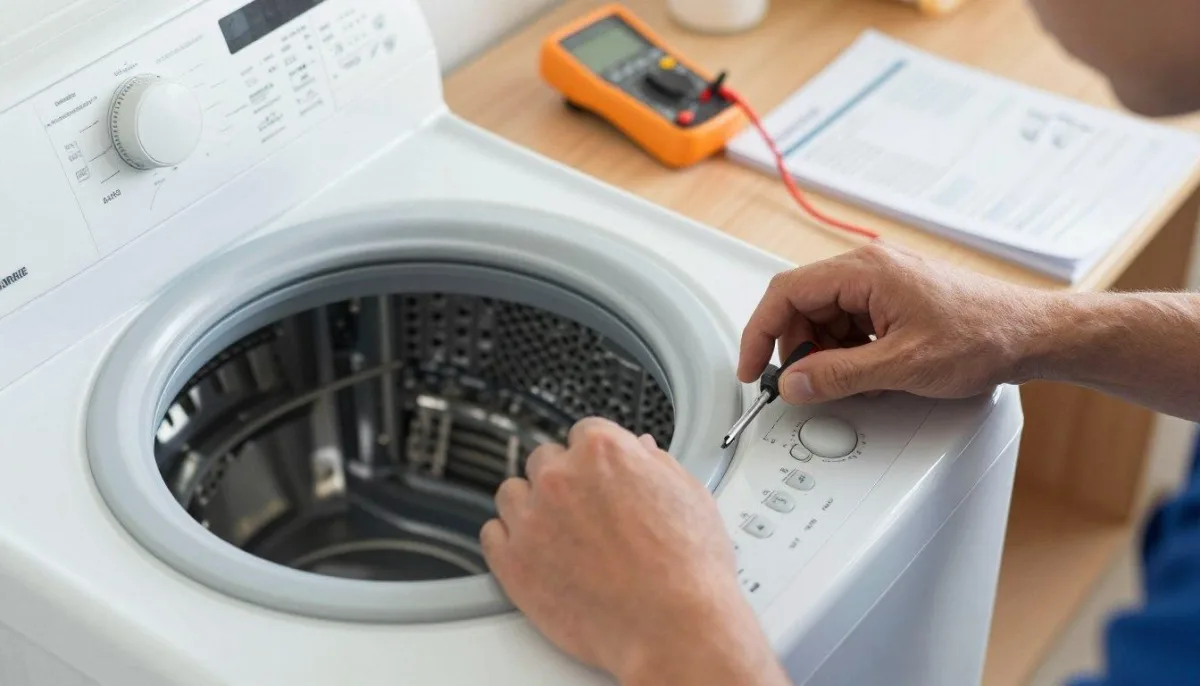
Step 8: Stop Before Unsafe Testing
Continuity, resistance, live-voltage, motor, pressure-sensor, and control-board diagnosis can require model-specific technical information.
If the simple checks fail, professional service is preferable to repeated cycling or unsafe internal access.
Expert Recommendations and Warranty Considerations
Do you know the right point to stop DIY troubleshooting?
Professional diagnosis becomes appropriate when:
- The washer repeatedly fails after basic checks.
- The motor runs but the basket remains stationary.
- The machine repeatedly trips a breaker.
- A burning smell appears.
- Internal wiring is damaged.
- A control-board fault is suspected.
- Major suspension or drive components require disassembly.
- Water will not drain despite cleaning accessible filters and hoses.
Before paying for a major repair, check whether your GE washer is covered by:
- Manufacturer warranty
- Retailer warranty
- Extended protection plan
- Property or appliance maintenance agreement
Coverage terms should be checked before work is authorized because exclusions, claim procedures, and eligible parts vary.
The original draft discussed a U.S.-specific Liberty Home Guard plan. Because this article is being published for a Dubai repair business, that U.S.-specific warranty promotion has been removed while preserving the useful warranty-checking advice.
For complex GE washer problems in Dubai, professional washing machine repair in Dubai provides the most relevant next step when basic troubleshooting no longer resolves the fault.
Conclusion
When facing a GE washer that fails to spin, first determine whether the machine is actually malfunctioning or simply completing its normal pause and pump-out sequence.
Troubleshooting should then move logically through:
- Electrical supply
- Lid or door interlocks
- Load balance
- Drainage
- Drive belt and coupling where fitted
- Suspension and leveling
- Water-level sensing
- Control errors
- Motor or electronic faults
Regular maintenance can reduce many spin-related problems. Check accessible filters and hoses, load the washer correctly, keep it level, and pay attention to recurring noises or error messages.
A model-appropriate control reset may resolve a temporary electronic interruption, but persistent errors require targeted diagnosis rather than repeated resets.
For related general troubleshooting, you can also read Is Your Washing Machine Not Spinning? Troubleshooting Tips.
If your General Electric washer still will not spin after safe basic checks, Super Fix Appliances provides professional washer diagnosis and repair across Dubai.
Frequently Asked Questions
What are common reasons for a washer not spinning?
Common causes include an unbalanced load, drainage problems, a faulty lid switch or door lock, a damaged drive belt on belt-driven models, drive-system faults, suspension problems, sensor issues, or electronic-control faults.
How can I check if the lid switch is functioning?
Start by checking whether the lid closes correctly and whether the washer recognizes that it is closed. Inspect for visible damage or misalignment while the machine is disconnected from power.
Electrical switch testing should only be carried out using the correct model-specific procedure. Never bypass the lid safety system.
What should I do if the drain pump is clogged?
Disconnect the washer from power and follow the owner's manual for accessing any user-serviceable filter. Remove accessible lint, coins, or debris and inspect the drain hose for kinks.
If the washer still fails to drain, the pump or another part of the drainage system may require professional diagnosis.
How can I tell if the drive belt is worn out?
On models that use a drive belt, look for cracking, fraying, stretching, slippage, or a completely broken belt.
Always confirm that the exact GE model actually uses that type of drive system before ordering a replacement.
What are the signs of a malfunctioning motor?
Possible symptoms include abnormal humming, overheating, difficulty starting, repeated stopping, burning odors, or a motor that appears to operate while the drum or basket remains stationary.
Because these symptoms can also result from other drive components, professional testing is advisable before replacing the motor.
How do I reset the control board?
The correct reset depends on the GE model and symptom.
For certain CAnCELEd conditions, GE recommends disconnecting power for approximately one minute after attempting Drain & Spin. GE's general electronic-control guidance recommends about two minutes on applicable models.
Check the exact model instructions rather than assuming one reset procedure applies to every washer.
What are the best practices for load distribution?
Load items loosely and evenly. Avoid packing the basket tightly or allowing heavy towels, jeans, blankets, or bedding to collect on one side.
If the washer reports an imbalance, redistribute the load and use Drain & Spin where appropriate.
How often should I perform maintenance on my washer?
Follow the maintenance schedule in the owner's manual. Regularly check user-serviceable filters, drainage hoses, leveling, lid or door components, and unusual noises.
The interval varies according to the washer model and how frequently it is used.
Is it better to repair or replace my washer?
Consider the washer's age, repair history, failed component, replacement-part availability, warranty coverage, repair quote, and the price of an equivalent new machine.
A single repair on an otherwise reliable washer may be worthwhile, while multiple expensive failures on an older unit can make replacement more practical.