




How to Clean Dishwasher Machine
Many people believe that their dishwashers stay clean simply because they wash dishes. However, this common assumption can lead to unpleasant surprises. Over time, food residue, grease, and mineral deposits can build up, creating unpleasant smells and affecting performance.
In this article, readers will discover an effective method for maintaining a dishwasher using a two-stage process with simple ingredients. Where the dishwasher manufacturer permits it, the approach involves using white vinegar followed by baking soda in separate cycles. This method can help remove grime and freshen the appliance.
Regular maintenance is crucial. Proper care can support the dishwasher's performance and service life. It’s essential to ensure the appliance is empty during a dedicated cleaning cycle and to follow the exact owner's manual before using household cleaning products. Manufacturer guidance differs, particularly when acids such as vinegar are involved.
For example, Whirlpool's official dishwasher-cleaning guide includes a vinegar-and-baking-soda cleaning method but warns that vinegar is acidic and excessive use may damage the appliance. Miele manuals also emphasize using manufacturer-approved cleaning products and warn against damaging acid concentrations.
Key Takeaways
- Regular dishwasher maintenance helps control food residue, grease, odors, and mineral buildup.
- Vinegar and baking soda may be suitable for some dishwashers when used separately and permitted by the manufacturer.
- Manufacturer cleaning instructions should always take priority.
- An empty maintenance cycle can help clean the dishwasher interior.
- Regular filter, seal, spray-arm, and tub care can support long-term performance.
Understanding the Importance of Regular Dishwasher Cleaning
It's a common misconception that dishwashers are completely self-cleaning appliances. Regular maintenance is important for consistent performance and hygiene. Neglecting filters, seals, spray arms, and internal residue can eventually affect how well the appliance cleans.
Keeping a dishwasher clean has several benefits:
- Regular cleaning removes food particles and grease that can interfere with washing performance.
- A monthly maintenance routine can be useful for frequently used machines, while cleaning frequency should ultimately follow the appliance manual and household usage.
- Many GE dishwashers include a Sanitize Cycle designed to meet NSF residential standards. GE Appliances explains that this type of cycle can reduce bacteria on dishes when the appliance supports the feature.
- Removing residue from the filter, seals, and tub helps reduce blockages and protects internal components.
- Consistent maintenance can support reliable performance throughout the dishwasher's service life.
Whirlpool similarly recommends periodic interior cleaning and notes that a monthly deep-cleaning routine can help tackle detergent, mineral, dirt, and odor-causing buildup.
Preparing Your Dishwasher for a Deep Clean
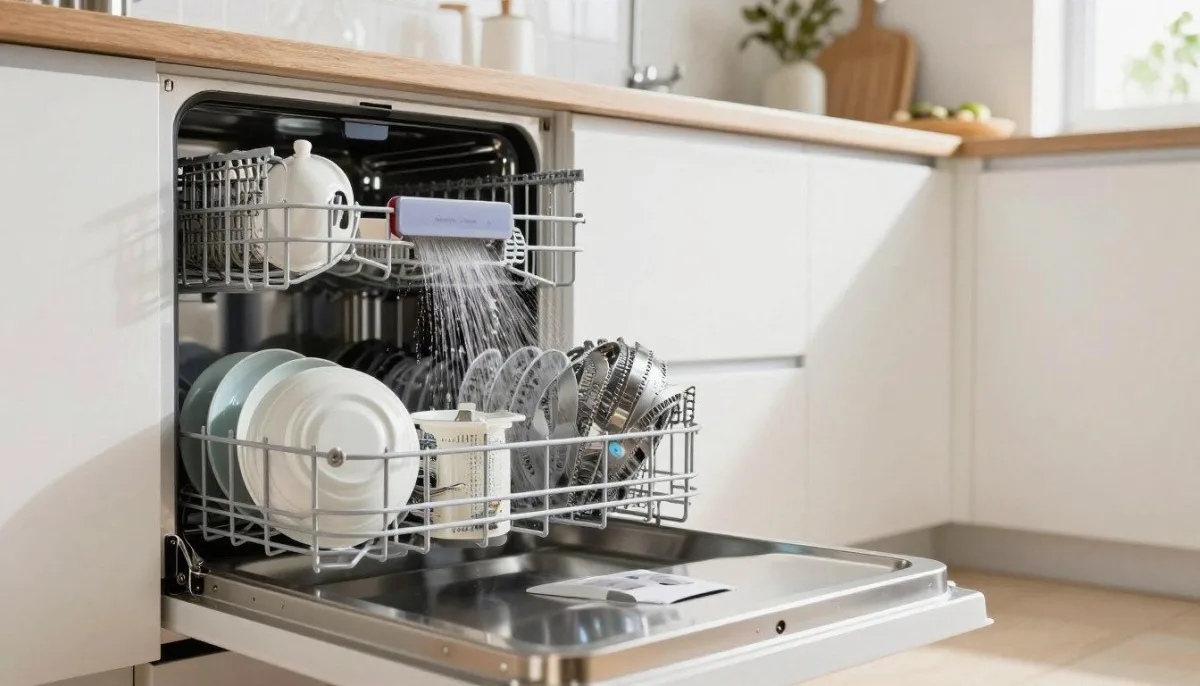
A thorough approach is necessary to ensure your dishwasher is ready for a deep clean. This preparation includes emptying the interior and gathering the right supplies. Following these steps will enhance the effectiveness of the cleaning process.
Start by removing dishes and, where necessary, the lower rack to access the bottom of the dishwasher. Check for:
- Food scraps
- Standing water
- Broken glass
- Labels or small debris
- Visible grease or grime
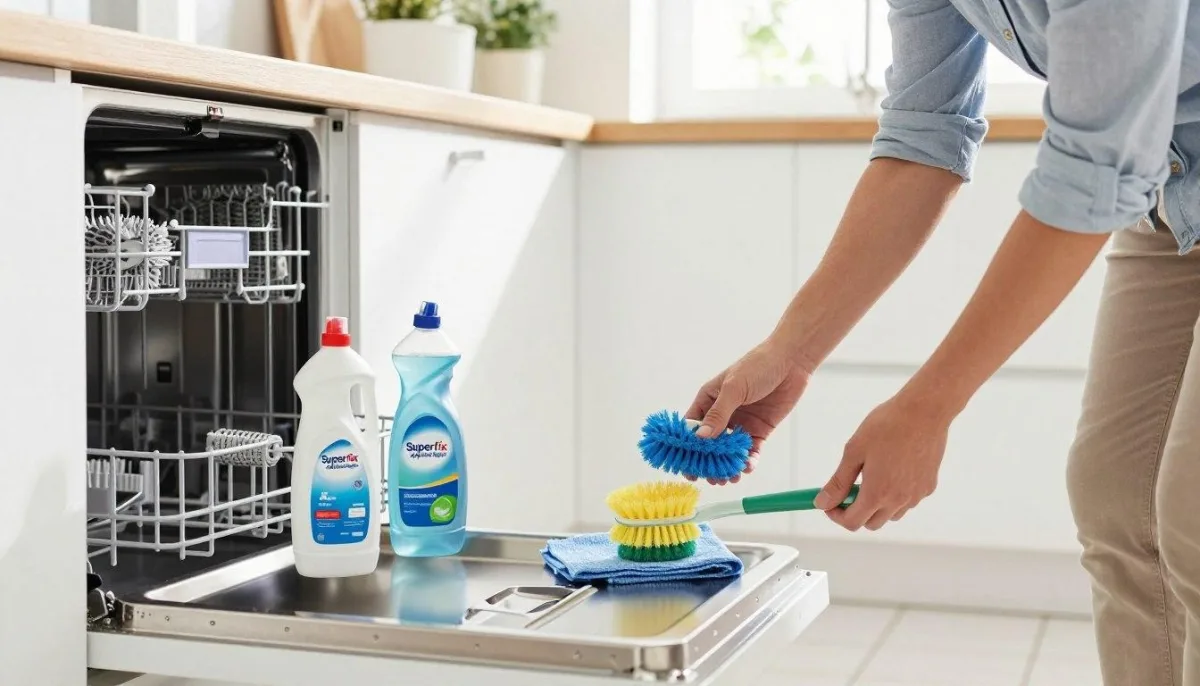
A soft, damp cloth, kitchen sponge, plastic scrubbing brush, and toothbrush can be useful for accessible surfaces. Avoid metal scourers or steel wool because abrasive materials can scratch or damage the dishwasher interior.
Next, pay special attention to the door seal and surrounding edges. Wiping these areas carefully can prevent trapped residue from contributing to unpleasant odors.
Water-temperature requirements vary by brand and model. Some machines are designed around incoming hot water of approximately 120°F, while others handle heating differently. Check the appliance manual rather than changing the water-heater setting solely for a cleaning cycle.
For normal dishwashing, scrape away large food scraps before loading. Full pre-rinsing is generally unnecessary on many modern dishwashers unless the manufacturer instructs otherwise.
Step-by-Step Guide: How to Clean Dishwasher Machine
The cleanliness of a dishwasher is often taken for granted, but it requires attention. Regular maintenance ensures that the appliance operates efficiently and helps produce consistently clean dishes.
Step 1: Empty the Dishwasher
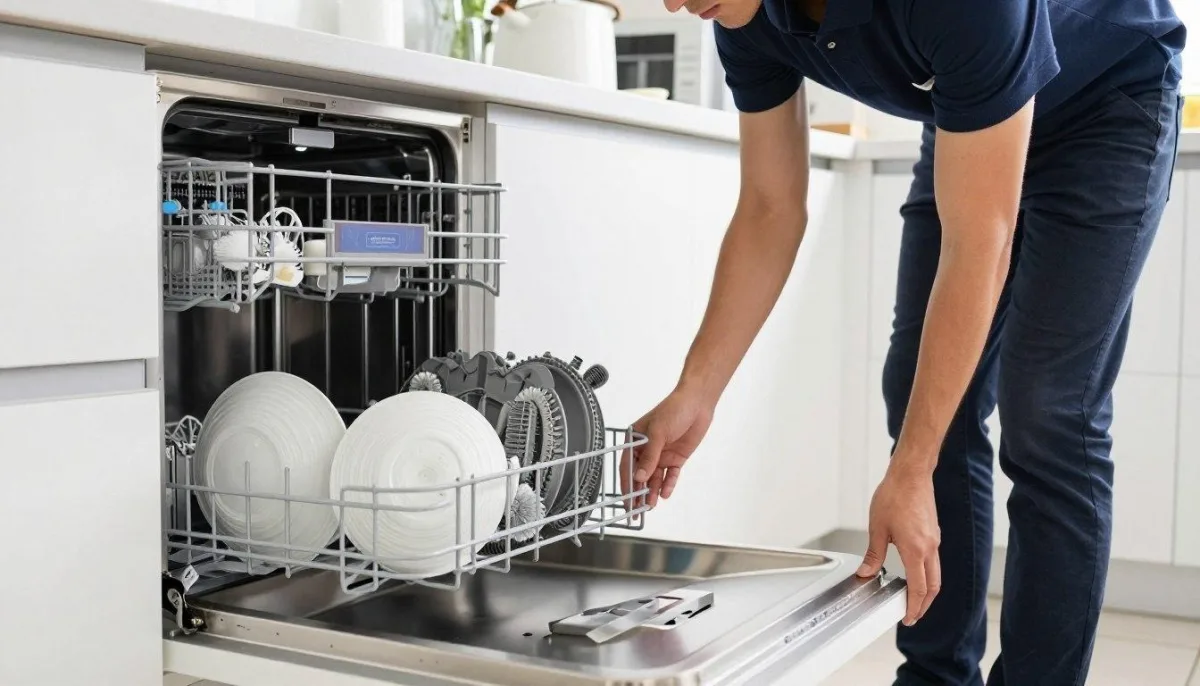
Remove all dishes, utensils, and loose food debris.
Inspect the bottom of the appliance and remove accessible residue before beginning a cleaning cycle.
Step 2: Clean with Vinegar if Your Manual Permits It
If your dishwasher manufacturer permits white vinegar for interior cleaning, place 1-2 cups of white vinegar in a dishwasher-safe container inside the empty dishwasher.
Do not pour concentrated vinegar directly over seals or components.
Whirlpool's official method uses two cups of white vinegar in a dishwasher-safe container and specifically notes that vinegar should not be overused because it is acidic. Always prioritize the instructions for your exact dishwasher model.
Step 3: Run a Hot or Normal Cleaning Cycle
Run the recommended cycle without regular dishwasher detergent.
If using the vinegar method, turn off Heated Dry where recommended by the manufacturer.
The original cleaning method suggests allowing additional soaking time where possible. Treat this as optional and only pause a cycle if your dishwasher normally allows it.
Step 4: Remove the Vinegar Container
Once the first cycle finishes, remove the bowl or measuring cup.
Step 5: Add Baking Soda
If compatible with your machine, sprinkle approximately 1 cup of baking soda across the bottom of the empty dishwasher.
Baking soda primarily helps neutralize lingering odors.
Step 6: Run a Second Short Hot Cycle
Run a separate hot-water cycle without detergent or dishes.
Do not combine vinegar and baking soda in the same container or cleaning step. Whirlpool's published method similarly uses vinegar first and baking soda afterward in separate stages.
| Step | Action | Notes |
|---|---|---|
| 1 | Empty dishwasher | Remove dishes and loose debris |
| 2 | Add vinegar if approved | 1-2 cups in a dishwasher-safe container |
| 3 | Run cycle | No detergent; follow model instructions |
| 4 | Remove container | Complete vinegar stage first |
| 5 | Add baking soda if approved | About 1 cup across the bottom |
| 6 | Run short cycle | No detergent or dishes |
Cleaning the Dishwasher Filter and Spray Arms
Neglecting the internal parts of a dishwasher can lead to performance issues. Regular attention to the filter and spray arms is essential for maintaining optimal cleaning efficiency.
Start by removing the bottom rack.
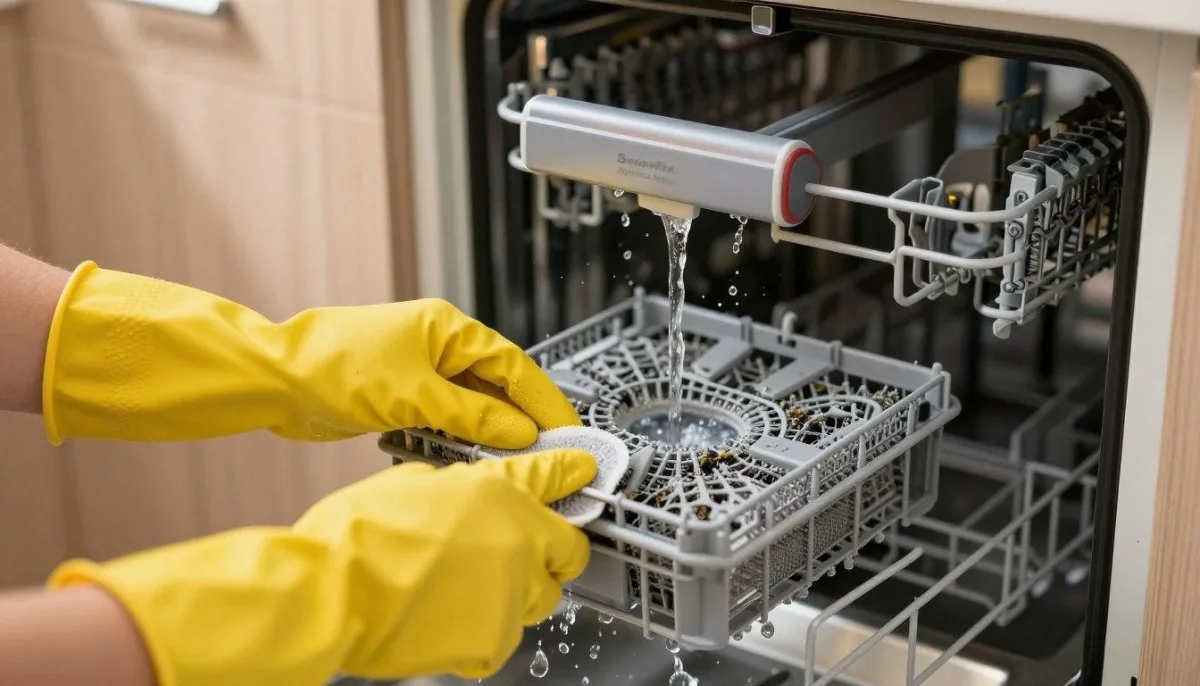
Locate the filter according to the manufacturer's instructions and, if it is designed to be user-removable, twist or unlock it gently.
Rinse the filter under warm water, using a plastic brush or toothbrush to scrub away grease and grime without damaging the mesh.
Removing and Soaking the Filter
For deeper cleaning, the original method uses equal parts warm water and white vinegar for about 20 minutes to loosen stubborn residue.
Because filter materials vary between brands, only use this vinegar soak if acidic cleaning is permitted for your dishwasher and filter.
After soaking:
- Rinse the filter thoroughly.
- Allow it to air-dry or drain.
- Reinstall it securely according to the manufacturer's instructions.
Unclogging the Spray Arms
Next, inspect the spray arms.
If your model allows user removal, remove each spray arm according to the appliance manual.
Clear blocked jets with a toothpick or soft pointed tool. Avoid sharp metal objects that could enlarge or damage the spray holes.
Rinse the spray arms thoroughly before reinstalling them, then make sure they rotate freely.
Miele's dishwasher operating instructions similarly recommend regularly checking filters and spray arms and cleaning blocked jets according to the appliance instructions.
| Step | Action | Notes |
|---|---|---|
| 1 | Remove bottom rack | Access the filter easily |
| 2 | Locate and remove filter | Follow manufacturer instructions |
| 3 | Rinse under warm water | Use a plastic brush for grime |
| 4 | Soak if compatible | Equal parts warm water and vinegar for about 20 minutes |
| 5 | Remove spray arms if permitted | Check for blockages |
| 6 | Clear jets | Use toothpick or soft tool; avoid sharp metal |
Effective Use of Natural Cleaners and Techniques
Some believe that simply using a dishwasher is enough to keep it clean. However, natural cleaners such as white vinegar and baking soda can play a useful role in regular maintenance when they are compatible with the appliance.
White vinegar can help loosen grease, discoloration, and some limescale, while baking soda serves primarily as a deodorizer.
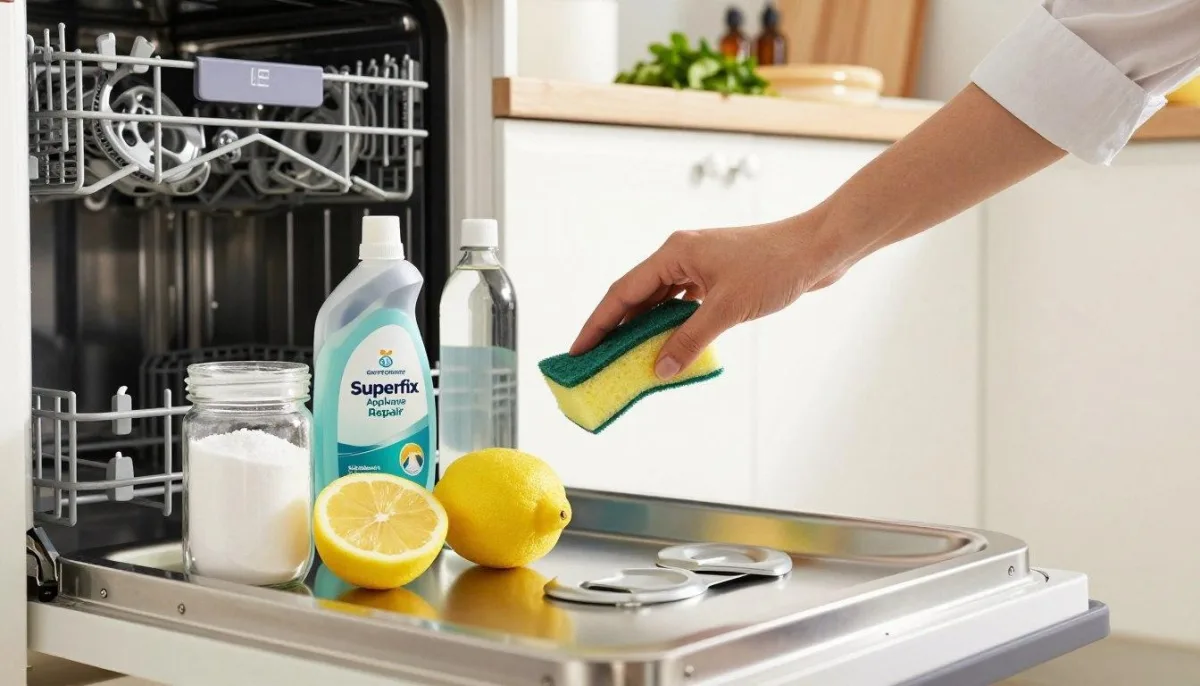
For models that permit vinegar cleaning, place up to two cups of vinegar in a dishwasher-safe bowl inside an empty machine. This keeps the vinegar contained while wash water carries diluted vinegar through the appliance.
After that cycle is complete, baking soda can be sprinkled across the bottom and used in a separate cycle to refresh the tub.
Commercial dishwasher cleaners may be more effective for heavy limescale or stubborn mineral deposits.
Always follow manufacturer guidelines. Some manufacturers prefer model-approved dishwasher cleaners rather than household acids.
Important Cleaning Safety
When using stronger cleaning products:
- Wear protective gloves where the product label recommends them.
- Keep the kitchen adequately ventilated.
- Follow the product's dilution and rinsing instructions.
- Never mix chlorine bleach with vinegar.
- Never mix bleach with another acidic cleaner.
- Do not combine household cleaning chemicals unless the product instructions explicitly permit it.
Addressing Common Issues and Troubleshooting
Understanding common problems can help maintain a dishwasher's efficiency.
Persistent odors often indicate:
- Grease
- Food particles
- Dirty or blocked filters
- Standing water
- Residue around door seals
- Drainage problems
Inspect the filter and the bottom dishwasher area regularly.
Using Baking Soda for Persistent Odors
One method from the original cleaning routine is to leave approximately 1 cup of baking soda in the empty dishwasher overnight, where your appliance manufacturer permits it.
Run a hot cycle the following morning to help flush away remaining residue and odors.
Baking soda can help neutralize smells, but a persistent bad odor should also prompt inspection for standing water, trapped food, mold, or a blocked drainage system.
If water is pooling at the bottom of the machine, see Dishwasher Not Draining in Dubai: The Real Reasons and Real Fixes before repeatedly running additional cleaning cycles.
Overcoming Grease and Odor Build-Up
For stubborn grease, ensure the filter is clean and wipe down the door seal and surrounding areas.
If you find mold, do not use a generic bleach recipe in every dishwasher.
Dishwasher tubs, seals, coatings, and internal components vary. Chlorine bleach can damage some materials, particularly some stainless-steel surfaces.
Only use bleach if the owner's manual for your exact model explicitly permits it. If permitted:
- Follow the manufacturer's dilution instructions rather than a generic ratio.
- Wear gloves.
- Ventilate the kitchen.
- Rinse as instructed.
- Never combine bleach with vinegar or another acidic cleaner.
This is the safest way to resolve the bleach contradiction while retaining the original section's intent. The source itself recommends bleach in one section but advises against it later in the FAQ.
Dealing with Hard Water Deposits
Hard water can cloud glassware and contribute to mineral buildup inside a dishwasher over time.
Regularly check for:
- White residue
- Limescale
- Cloudy glassware
- Restricted spray jets
- Mineral deposits around internal components
Consider using a dishwasher cleaner specifically designed for hard-water deposits and approved for your model.
If your appliance has a built-in water-softening system, dishwasher salt may also be required according to the manufacturer's instructions.
Do not mix bleach with vinegar, descaling acids, or other cleaners.
If cleaning does not resolve persistent odors, poor washing, drainage problems, or mineral-related faults, professional dishwasher repair in Dubai can help determine whether a filter, pump, drain system, spray arm, wash pump, heater, or another component requires repair.
Tips and Maintenance Tricks for a Spotless Dishwasher
Maintaining a spotless dishwasher requires more than just regular use. Scheduling regular cleaning cycles is essential for optimal performance.
Monthly Maintenance
Most frequently used household dishwashers can benefit from a monthly filter and interior check or clean, subject to the manufacturer's maintenance schedule.
Lighter-Use Dishwashers
Homes that use the dishwasher less frequently may sometimes extend deeper cleaning to approximately every three months, provided there is no odor, visible buildup, drainage problem, or manufacturer requirement for more frequent maintenance.
Busy Kitchens
For heavily used machines, clean more often whenever you notice:
- Grease
- Odors
- Food residue
- Mineral buildup
- Reduced cleaning performance
Check the Bottom After Each Load
A quick inspection of the bottom of the dishwasher after each load can help catch:
- Food scraps
- Broken glass
- Labels
- Standing water
- Other debris
before it creates a larger blockage.
Wipe the Door Seal
Regularly wipe the door seal and surrounding edges with a soft, damp cloth.
These areas are not always directly cleaned by the spray arms and can collect food residue and moisture.
Keep Spray Arms Clear
Inspect spray-arm holes and make sure no dishes, utensils, or racks prevent the arms from rotating normally.
Improve Ventilation
Where the appliance manual permits it and it is safe in your household, leaving the dishwasher door slightly ajar between cycles can improve air circulation and help reduce trapped moisture and unpleasant odors.
Check Water Temperature
For dishwashers designed around incoming hot water, approximately 120°F (49°C) is commonly recommended by manufacturers such as GE.
Always check your exact model and home water-heater instructions before adjusting temperatures.
Keep the Detergent Dispenser Clear
Load dishes so that trays, pans, utensils, or other items do not obstruct the detergent dispenser.
Correct loading helps detergent release properly and allows the spray arms to reach the dishes.
Conclusion
Maintaining a clean dishwasher is essential for both performance and the longevity of the appliance.
A complete cleaning routine includes:
- Removing food debris
- Caring for the filter
- Inspecting and clearing spray arms
- Wiping the door seal
- Checking the bottom after loads
- Monitoring hard-water buildup
- Using compatible cleaning products
Where the manufacturer permits it, following a vinegar cleaning cycle with a separate baking-soda cycle can help freshen the interior.
Regularly cleaning the filter supports optimal performance, while food scraps and grime should be cleared from the bottom before they cause a blockage.
For homes with hard water, consider rinse aid, dishwasher salt where required, or a specialized dishwasher cleaner to manage mineral buildup.
Consistent monthly maintenance is practical for many households, while lighter-use homes may sometimes extend deeper cleaning to around three months if the appliance remains clean and the manufacturer permits it.
Correct loading, keeping the detergent dispenser unobstructed, and maintaining the appropriate incoming water temperature for the appliance also support consistent washing results.
Safe cleaning practices include avoiding steel wool, protecting seals and finishes, following chemical labels, and never mixing bleach with vinegar or other acidic cleaners.
If regular cleaning no longer resolves odors, poor cleaning, drainage problems, leakage, or other recurring faults, Super Fix Appliances provides professional appliance repair in Dubai, including dedicated dishwasher repair services.
With consistent care and timely maintenance, a dishwasher can continue operating reliably for many years.
Frequently Asked Questions
What are the signs that a dishwasher needs cleaning?
Common signs include unpleasant odors, residue on dishes, visible grime, food debris around the filter, mineral buildup, and reduced cleaning performance.
Regular checks can help identify these issues early.
Can vinegar harm my dishwasher?
Vinegar is used in cleaning guidance for some dishwashers, but it is acidic and is not universally suitable for every model.
Incorrect or excessive use may damage sensitive components or seals. Check your owner's manual before using vinegar.
How often should the filter be cleaned?
For frequently used dishwashers, a monthly filter check or clean can be a practical routine.
Lighter-use households may sometimes clean less frequently, but the manufacturer's maintenance interval should always take priority.
Is baking soda effective for eliminating odors?
Yes. Baking soda is a useful natural deodorizer and can help absorb unwanted smells.
Where compatible with your dishwasher, it can be used after a vinegar cycle or left in an empty dishwasher overnight before running a hot cycle the next morning.
What should I do if my dishwasher is still dirty after cleaning?
Check:
- Filter
- Spray arms
- Bottom drain area
- Door seals
- Detergent dispenser
- Loading
- Water supply
- Hard-water buildup
If problems persist, use a manufacturer-approved dishwasher cleaner or have the appliance professionally diagnosed rather than repeatedly running household-cleaner cycles.
Are there specific products recommended for dishwasher cleaning?
Yes. Many manufacturers offer or recommend purpose-made dishwasher cleaners designed to target grease, mineral deposits, limescale, and odor-causing residue.
Choose a product specifically labeled as safe for your dishwasher and follow its directions.
Can I use bleach to clean my dishwasher?
Only if the owner's manual for your exact model explicitly permits chlorine bleach.
Do not treat bleach as a universal dishwasher cleaner. It can damage certain components and finishes, particularly some stainless-steel interiors.
Never mix bleach with vinegar or another acidic cleaner.
What is the best way to maintain a clean dishwasher?
Regularly:
- Remove food debris.
- Check and clean the filter.
- Inspect spray arms.
- Wipe door seals.
- Monitor hard-water buildup.
- Keep the detergent dispenser unobstructed.
- Run manufacturer-approved maintenance cycles.
- Use only compatible cleaning products.