




Fridge Normal Temperature: Safe Settings Explained
Have you ever wondered if the settings on your refrigerator truly keep your food safe? Many people assume that any cold setting is sufficient, but that might not be the case. Understanding the ideal conditions for food storage can make a significant difference in freshness and safety.
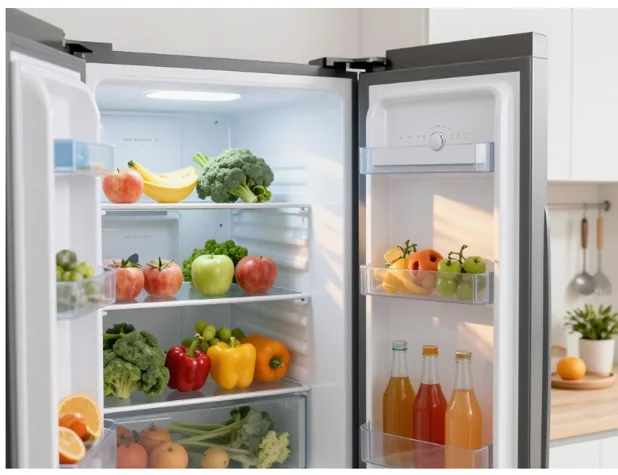
The United States Food and Drug Administration recommends keeping refrigerators at or below 4°C (40°F). This helps slow the growth of harmful bacteria and reduces spoilage. Dubai Municipality also advises keeping refrigerators at 4°C or less and freezers at -18°C or less.
A practical refrigerator operating range of roughly 1.7°C to 3.3°C (35°F to 38°F) also provides some buffer below the 4°C food-safety ceiling. ENERGY STAR recommends this range for household refrigerators.
In UAE homes, where refrigerators may experience frequent door openings and high surrounding temperatures, keeping settings stable is especially important.
At Super Fix Appliances, refrigerator and home-appliance repair services are available across Dubai for cooling, temperature-control, airflow, and related appliance problems.
This guide covers controls, thermometers, freezer settings, airflow, energy-saving practices, and troubleshooting to help you maintain safer conditions for stored food.
Key Takeaways
- Keep your refrigerator at 4°C or below.
- A practical target of around 1.7°C to 3.3°C provides a buffer below the food-safety ceiling.
- Keep your freezer at -18°C or below.
- Use an appliance thermometer to verify actual temperature.
- Do not assume numbered control settings represent degrees Celsius.
- Avoid overcrowding shelves or blocking vents.
- Persistent temperature problems may indicate a seal, thermostat, fan, sensor, defrost, or cooling-system fault.
Understanding the Ideal Fridge Normal Temperature
Understanding the right settings for your refrigerator can significantly affect food safety.
The FDA recommends a refrigerator temperature of 4°C or below. Cold temperatures slow the growth of harmful bacteria, helping food remain safer for longer.
For everyday operation, a range around 1.7°C to 3.3°C is commonly suitable for household refrigerators while still remaining safely below 4°C.
It is also important to remember that temperature may vary within the compartment. Door shelves experience frequent exposure to room-temperature air, while some interior areas can remain colder.
| Temperature | Food-Safety Meaning | Practical Note |
|---|---|---|
| 1.7°C to 3.3°C | Good operating range | Provides buffer below 4°C |
| 4°C or below | FDA and Dubai Municipality safety limit | Keep refrigerator at or below this level |
| Above 4°C | Increased food-safety and spoilage risk | Investigate if temperature remains high |
The original table suggested that temperatures above 4°C automatically cause higher energy use. I removed that claim because food-safety risk and energy consumption are separate issues.
How to Set and Adjust Your Refrigerator Temperature
Setting the right controls is crucial for maintaining safe refrigerator conditions.
Controls may be located on:
- An interior panel
- An exterior digital display
- A slider or dial
- The rear or side wall
- A refrigerator or freezer control panel
Numbered Refrigerator Controls
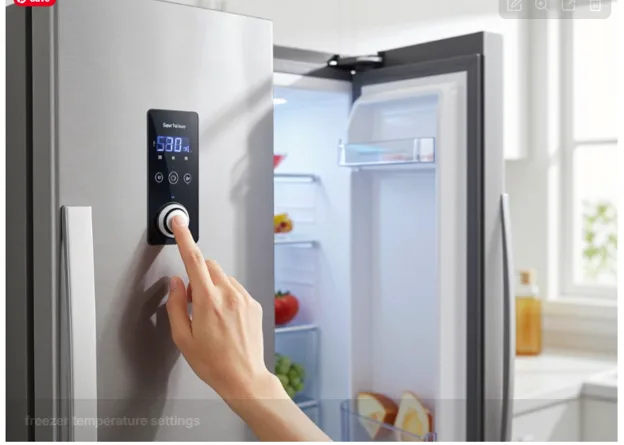
Many refrigerators use numbered controls such as 1 to 5 or 1 to 9.
These numbers generally indicate cooling levels rather than exact temperatures.
For example, a setting marked 3 does not necessarily mean 3°C.
Whether a higher number means colder or warmer can also vary by model, so consult your refrigerator manual rather than assuming how the dial works.
Digital Temperature Controls
Digital controls are easier to interpret because they may display the intended temperature directly.
Even then, the displayed set point and the actual food-compartment temperature may not always be identical.
That is why an independent appliance thermometer is useful.
After changing the setting, allow enough time for the refrigerator to stabilize before making another adjustment.
Exploring Freezer Temperature Settings and Maintenance
Maintaining proper freezer conditions is important for long-term food storage.
The recommended freezer temperature is -18°C (0°F) or below. Both FDA and Dubai Municipality guidance use this benchmark.
Consistent freezing helps preserve food quality and keeps food fully frozen.
Temperature fluctuations that repeatedly partially thaw and refreeze food can negatively affect texture and overall quality.
When checking freezer temperature, use a freezer-safe appliance thermometer and allow the reading enough time to stabilize.
Avoid packing the freezer so tightly that vents or airflow pathways become blocked.
Monitoring Your Refrigerator's Performance
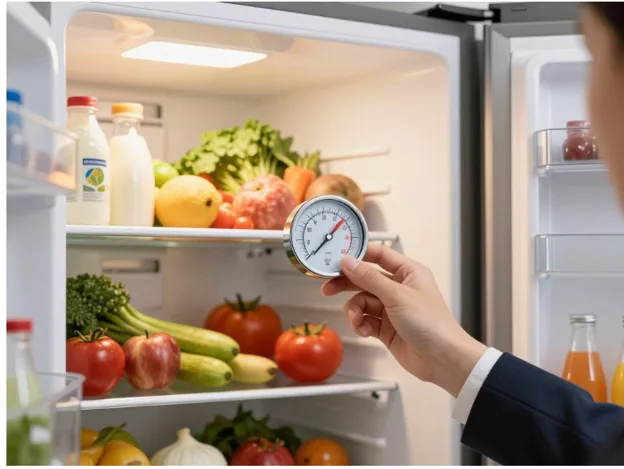
An independent thermometer can help confirm whether the refrigerator's display or control setting reflects the actual internal temperature.
The FDA recommends using an appliance thermometer because many refrigerator controls do not show the actual compartment temperature.
FDA Refrigerator Thermometer Guidance
How to Check the Temperature
Place an appliance thermometer near the middle of the refrigerator and allow the temperature to stabilize.
FDA guidance indicates that after several hours, typically around 5 to 8 hours, the reading can be used to determine whether an adjustment is necessary.
For the freezer, place the thermometer between frozen packages and give it enough time to stabilize before judging the result.
| Thermometer | Placement | Reading Goal |
|---|---|---|
| Refrigerator thermometer | Middle of main compartment | 4°C or below |
| Freezer thermometer | Between frozen packages | -18°C or below |
| Built-in digital display | Appliance control panel | Verify against actual thermometer reading |
Temperature distribution varies by refrigerator design, so do not assume that the bottom, top, front, or back is always the coldest location in every model.
Managing Temperature in Multi-Door and Integrated Fridge-Freezers
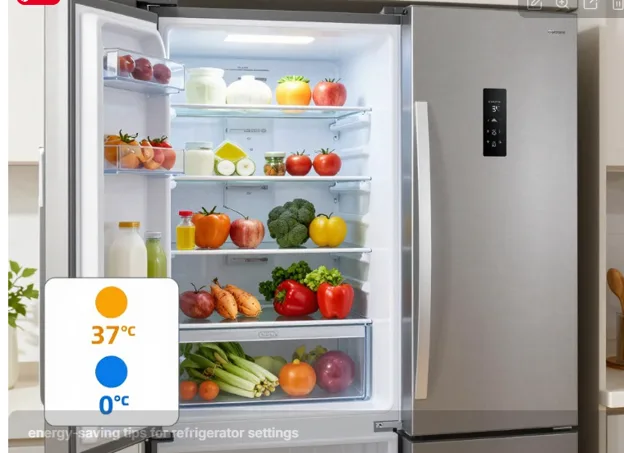
Multi-door refrigerators can maintain different conditions across separate compartments.
Fresh-food zones, vegetable drawers, convertible compartments, and freezer sections may have individual airflow systems or temperature controls.
To support stable cooling:
- Leave space around stored items.
- Do not block air vents.
- Avoid packing shelves too tightly.
- Limit unnecessary door openings.
- Use the manufacturer's recommended settings for special compartments.
- Check actual temperatures when you suspect uneven cooling.
Modern refrigerators may use multi-airflow systems, separate evaporators, smart temperature sensors, or independent cooling zones to maintain more consistent conditions.
The exact technology varies by manufacturer and model.
Energy-Saving Tips and Food Storage Best Practices
Proper refrigerator use can support both food preservation and energy efficiency.
ENERGY STAR recommends keeping refrigerators around 35°F to 38°F (1.7°C to 3.3°C), checking door seals, minimizing door-opening time, and allowing ventilation around the appliance.
ENERGY STAR Refrigerator Guidance
Useful habits include:
- Keep the refrigerator door closed whenever possible.
- Do not set the fridge unnecessarily colder than needed.
- Avoid blocking internal air vents.
- Keep food organized so cold air can circulate.
- Check door seals for gaps or damage.
- Allow proper ventilation around the refrigerator according to the manual.
- Keep accessible condenser areas clean if your model requires it.
| Best Practice | Benefit |
|---|---|
| Maintain safe temperature | Protects food quality and safety |
| Avoid overcrowding | Improves airflow |
| Limit door openings | Reduces warm-air entry |
| Check door seals | Reduces cold-air leakage |
| Keep vents clear | Supports consistent cooling |
For a broader look at appliance care and longevity, you can also read Why Regular Dishwasher Services Are Essential for Longevity?. The current Super Fix blog archive lists it alongside the site's other appliance-maintenance guides.
Troubleshooting Common Temperature Issues
Recognizing abnormal temperature changes early can help prevent food spoilage.
If your refrigerator repeatedly rises above 4°C or your freezer cannot maintain -18°C, start with the simplest checks.
1. Check the Temperature Setting
Make sure the control has not been accidentally changed.
Do not make several rapid adjustments. Change the setting once, allow the appliance time to stabilize, and measure again.
2. Check the Door Seal
Look for:
- Gaps
- Tears
- Dirt buildup
- Loose sections
- Areas where the door does not close evenly
A leaking gasket allows warm air into the cabinet and forces the cooling system to work harder.
3. Check the Air Vents
Food containers pushed against internal vents can interrupt airflow and create uneven temperatures.
4. Check for Overloading
An overloaded refrigerator can restrict cold-air movement.
5. Listen for Unusual Sounds
Grinding, buzzing, rattling, clicking, or squealing combined with unstable temperatures may indicate a fan, compressor, ice-buildup, or other mechanical problem.
For noise-related symptoms, read Why Is My Fridge Making Loud Noises? Common Repair Solutions. That Super Fix guide covers compressor, condenser-fan, evaporator-fan, ice-buildup, and thermostat-related clues.
6. Know When Temperature Problems Need Repair
If temperatures remain unsafe after basic checks, the problem may involve:
- Thermostat
- Temperature sensor
- Evaporator fan
- Condenser fan
- Door gasket
- Defrost system
- Refrigerant system
- Compressor
- Electronic control board
For ongoing cooling problems in Dubai, Refrigerator Repair Dubai is the most relevant Super Fix service page. The service specifically includes temperature fluctuation troubleshooting, thermostat and control repair, fan replacement, defrost repair, gasket replacement, refrigerant work, and compressor diagnosis.
Conclusion
Keeping your refrigerator at the correct temperature is essential for food safety and freshness.
For UAE households, keep the refrigerator at 4°C or below and the freezer at -18°C or below. Dubai Municipality and FDA guidance both support these limits.
A daily refrigerator target around 1.7°C to 3.3°C gives useful headroom below the 4°C safety ceiling.
Use an appliance thermometer to verify actual conditions rather than relying solely on control positions or digital set points.
Keep doors closed, leave enough room for airflow, avoid blocking vents, inspect seals, and allow the refrigerator time to stabilize after changing settings.
If the appliance repeatedly fails to maintain a safe temperature, professional diagnosis may be necessary.
Frequently Asked Questions
What is the ideal fridge normal temperature?
A refrigerator should remain at 4°C or below. A practical household operating target is often around 1.7°C to 3.3°C.
How can I check if my fridge is at the right temperature?
Use an appliance thermometer placed near the middle of the refrigerator. Allow several hours for the reading to stabilize before making an adjustment.
What temperature should my freezer be set to?
Keep the freezer at -18°C (0°F) or below.
How often should I check refrigerator temperature?
Check periodically and whenever food seems warmer than usual, after a power interruption, after changing settings, or when you suspect a cooling problem.
What should I do if my refrigerator is too warm?
Check the control setting, door seal, airflow vents, door closure, and whether the refrigerator is overloaded. If it still remains above 4°C, professional diagnosis may be needed.
Why is humidity control important in a refrigerator?
Humidity control can help maintain the texture and freshness of fruits and vegetables, especially in dedicated crisper drawers.
How can I save energy while keeping food fresh?
Use appropriate temperature settings, limit unnecessary door openings, maintain airflow, check door seals, and follow the manufacturer's ventilation and maintenance instructions.
What causes refrigerator temperature fluctuations?
Common causes include frequent door openings, blocked vents, damaged door seals, thermostat or sensor problems, fan faults, defrost issues, refrigerant problems, or compressor faults.
How does air circulation affect refrigerator performance?
Cold air needs space to circulate. Overcrowding shelves or blocking vents can create uneven temperatures and reduce cooling performance.